When I first read the set reading I felt oddly disturbed. During my career I read a large number of written pieces by persons who were mentally disturbed or mentally ill. The structure of Althusser's work was strongly reminiscent of those pieces. The 'internal conversation' that attempts to meet possible criticism or misunderstanding of what he has written and the almost 'stream of consciousness' way of writing left me with the strong impression that here was someone who was or very recently had been mentally ill. I therefore looked further into his background and was not surprised to find a history of mental illness and time spent in Institutions. I was surprised to find that he had strangled his wife. No action had been taken because at that time French law did not allow for the trial of someone who was, at the time of the event, deemed to be not in control of his actions.
I am not competent to judge whether his illness affected the viability of his work although there are critics particularly after he undertook during the late 1960's and 70's ( which encompasses the time of the set reading) to revise some of his earlier work. Some saw these revisions as a betrayal of his previous theoretical accomplishments (which are considerable by any standards) and that there was an element of political motivation. (Althusser was a Marxist and during the 60's, particularly among French Communists, and there was considerable disquiet about the way that Communism was being practiced particularly by Stalin in Russia.) Others saw the revisions as showing that his work as a whole was self-contradictory. Others have argued that the revisions are consistent with what they see as the goal of Althusser's work - the development of a political philosophy that could be the foundation for political practice.
In the Course material we are told that : "Althusser reformulated the classical Marxist base/superstructure, giving, inter alia, the creative arts a more active part and questioning the primacy of the orthodox base." There is no indication during which period this took place. However we are told in the following sentence that "He [Althusser] and Lucan are often cited (unfortunately we are not told by whom) as amongst the more important figures in Structuralism and the events in Paris in 1964". The reason that the timing seems important to me is in the introduction to 'Louis Althusser (1918 -1990) from 'Ideology and Ideological State Apparatuses' [Art in Theory 1900 - 2000 An Anthology of Changing Ideas eds Charles Harrison & Paul Wood pp 953 Blackwell Publishing New Edition 2003] it is posited "....increasingly under the influence of Maoism and of the Events of 1968, Althusser's thoughts turned through 180 degrees. Marxism's virtue no longer lay in its status as a (scientific) theory of social formations but in its partisanship as theoretical practice in the class struggle. The sphere of ideology became a crucial site of the struggle: the intellectual and moral means whereby class societies reproduced themselves and where revolutionaries challenged them." If this volte face did occur is it safe to accept his earlier pronunciations on the place of creative art?
Structuralism seems to take many forms and there seems to be no one agreed definition or in some cases no definition at all in learned works each author using it a slightly different way in support of their work.
There may be common elements (see the work of Alison Assiter) but these are not self-evident nor would all users of the term agree. In the summary at the head of her paper in The British Journal of Sociology Volume XXXV Number 2 June 1984 Assiter writes " "Louis Althusser's work is often mentioned as being both structuralist and Marxist....I....argue that Althusser is not both structuralist and Marxist simultaneously. I conclude therefore, that, at least as far as Althusser's work is concerned - and his writings are taken to be paradigmatic of structuralist Marxism - it is misleading to lump together structuralism and Marxism."
On the same page (I was unable to access the complete article) she quotes Althusser - 'We believe that despite the terminological ambiguity, the profound tendency of our texts was not attached to the "structuralist" ideology'. In essence he denies he is 'structuralist'. However to quote from the definition given in Wikipedia "Structuralism argues that a specific domain of culture may be understood by means of a structure - modelled on language - that is distinct both from the organizations of reality and those of ideas or the imagination......in Althusser's Marxist theory, the structural order of the capitalist mode of production is distinct both from the actual, real agents involved in its relations and from the ideological forms in which those relations are understood."
In the required reading Althusser states (p957) - "Ideology is a 'Representation' of the Imaginary Relationship of Individuals to their Real Conditions of Existence". He goes on - "...while admitting that they [Ideologies] do not correspond to reality i.e that they constitute an illusion, we admit that they do make an allusion to reality, and that they only need to be 'interpreted' to discover the reality of the world behind their imaginary representation of that world (ideology = illusion/allusion)." Certainly this statement implies a structuralist approach.
Can this apparent conflict between the denial of Althusser that his texts were not "attached to the 'structuralist' ideology" be reconciled with his comments on ideology. Structuralism as an intellectual movement developed in France in the 1950's and 60's and Althusser could not fail to be aware of its underlying approach and the importance given to it by linguists, anthropologists, and other philosophers. There is a view, suggested by Spinoza, that authors are 'bound' by the ideas and ideology of the times in which they live and they, like all of us, understand things through the ideas and concepts that are available to us. If this is the case then Althusser would be 'bound' by the structuralist ideology that would be a major part of the world in which he lived. He could not avoid using the language of 'structuralism' because that was the dominant theme of the time.
The final question that we are asked to consider "Is there, in your view, an area of visual culture where this idea may seem to act in an overt way?" I am not sure what is meant by "this idea" so I am not sure how to respond. If it is a reference to the immediately preceding question that asks what does Althusser mean by 'ideology' then I have to consider whether there is an area of visual culture of the representation of the imaginary relationship of individuals to their real conditions of existence that is overt. My initial response is to say that the inclusion of the word 'overt' negates the proposition. Whilst much of what we see, say in advertising, is designed to support our ideas of the world we believe we live in ( that we can all own the latest gadget, drive the most luxurious car and look like the latest fashion icon by buying a particular product) I would question whether such advertising is 'overt'. In fact the underlying message is usually subliminal and offers a view of a world that is no more 'real' than the one in which we believe in.
Thursday, 1 September 2011

Tuesday, 30 August 2011
Whoops!! - Edited the wrong thing
Thought I ought to point out that I managed to edit my draft Man and the Coast Blog of 23rd August and replace the revised blog in the same place. This leads to the rather bizarre situation of my response to my tutor's comments that relate to the original draft come after the revised version.
Monday, 29 August 2011
DPP - Tutor's Response to draft Assignment 5 and my reply
Had my tutor's response to my draft submission for assignment 5. He raises a number of issues to which I have responded.
- Whether or not having a consistent aspect ration - i.e. all images of the same proportions - would be beneficial
I am never sure about this because images often lend themselves to a particular ratio for example letter 'box'. I know it exercised my mind a great deal when I was preparing a submission for my LRPS as it was deemed to be important that the panel presented a coherent whole. I can try both the present form of layout and the consistent one and see if either is better than the other.
- The inclusion of black and white images.
My tutor understood why I had included black and white images to show what I had learnt. He went on to suggest that I should consider using black and white images for a specific subject matter within the portfolio. I had not thought of this and the idea is appealing and well worth trying. It clearly would add a level of coherence and would avoid the impression that Black and White images had just been added because I thought that I had to include them.
- Think about the relationship - in design and competition terms - between 'empty spaces' in your images and areas of interest - the man-made features.
I have undertaken to look again at the pictures in terms of relationship between empty spaces and the object. I made a deliberate choice to emphasise the vastness of the sky and sea whilst including the obtrusive elements. I felt there was a risk of over-emphasising the intrusion of the man-made objects if the ratio was wrong.
- Weather. Would shooting in varying weather conditions add an additional element of interest.
I did try different weather shots (practically unavoidable this summer!) but my thinking on this was to keep the concept of happy sunny times at the seaside that is how many remember their childhood trips. Although probably more representative of the British weather cloudy days, or rain, 'dampened' the hoped for idyllic picture.
- Your man and the coast theme is mainly concerned with man-made objects. As a theme it works well but I wonder if you explored the possibility of also focusing on activities that people do.
This comment made me realise that I had unconsciously shied away from the inclusion of people. For some reason I am uncomfortable with those type of shots and so try to avoid them. I need to step outside my comfort zone because the exclusion of people is to miss the fact that often it is the crowds of people that flock to the Coast that can have a major impact on everything, particularly the enjoyment of the individual.
Whilst typing this blog and considering the tutor's response to my draft submission I realised that I had created a portfolio that, by choice of images, had lent weight to my initial premiss. In a sense there is an element of misleading the audience, not by the alteration or enhancement of the individual image but by the overall presentation. The world presented exists but what is offered is not representative of what would be considered the 'real' world. Superficially it seems a harmless deceit but is not all deceit wrong?
Tuesday, 23 August 2011
Visual Studies 1 - UVC Base & Superstructure
From the given that in order to survive as an individual and as a species it is necessary for humans to continually produce the necessities for sustaining life. In order to do this there is a need for the individual to enter into, willingly or unwillingly, relationships with others who have the same need. [This is accepted as a 'given' and that no other alternatives did or can exist. Whether this is true I know not!].
Marx argued that this was the foundation for the understanding of the development of society through the ages. He furthered his argument by stressing the importance of the constraints imposed by the nature of labour that required people to enter into definite relationships, one with another, and that ad-hoc or casual relationships would fail to meet the needs of the group. Marx, using the term, productive relationships, identified such relationships as the economic base of of society. From this economic base there arises the superstructure of society - ideas about acceptable behaviour, laws, religion, political institutions and customs.
As the tools of the economic base change the productive relationships change, so will the superstructure as it adjusts to the tensions that arise from these relationship changes. Stresses that are not released by adjustments accepted by the majority lead to conflict and sometimes violent revolution. Tensions are inevitable as the old ruling class fights with all the means at their disposal to retain the status quo that serves them so well. Recent events in the Middle East are an example. History suggests that the overthrow of one ruling class will lead to the rise of another that may be more enlightened but are equally as keen to hang on to the privileges that come from their new status.
I found Chandler's comments on base and superstructure confusing and without structure. In essence nothing made sense to me which is a comment on me rather than Chandler's work. It may also be that I was unclear whether to stay with the request in the Course material to read the section entitled 'Base and Superstructure' or to study the other articles.
I see very little difference between the looking at society in general or the media and the arts. The media and the arts are not separate from the society in which they exist and are constrained by what they do by the norms of that society. Whilst it can be argued that the individual artist can attempt to live outside these norms the very act of doing so presumes a knowledge of what those norms are and what impact they have on the individual. It is impossible to live outside of a society because of the need to acquire in some way the means of survival. The economic structure of any modern society is inextricably linked to all that goes on within that society and as long as there remains a concept of individual ownership of 'property' this will remain the case. I presume not even the most anti-society artist would happily stand by whilst someone takes a piece of work that strikes their fancy.
Marx argued that this was the foundation for the understanding of the development of society through the ages. He furthered his argument by stressing the importance of the constraints imposed by the nature of labour that required people to enter into definite relationships, one with another, and that ad-hoc or casual relationships would fail to meet the needs of the group. Marx, using the term, productive relationships, identified such relationships as the economic base of of society. From this economic base there arises the superstructure of society - ideas about acceptable behaviour, laws, religion, political institutions and customs.
As the tools of the economic base change the productive relationships change, so will the superstructure as it adjusts to the tensions that arise from these relationship changes. Stresses that are not released by adjustments accepted by the majority lead to conflict and sometimes violent revolution. Tensions are inevitable as the old ruling class fights with all the means at their disposal to retain the status quo that serves them so well. Recent events in the Middle East are an example. History suggests that the overthrow of one ruling class will lead to the rise of another that may be more enlightened but are equally as keen to hang on to the privileges that come from their new status.
I found Chandler's comments on base and superstructure confusing and without structure. In essence nothing made sense to me which is a comment on me rather than Chandler's work. It may also be that I was unclear whether to stay with the request in the Course material to read the section entitled 'Base and Superstructure' or to study the other articles.
I see very little difference between the looking at society in general or the media and the arts. The media and the arts are not separate from the society in which they exist and are constrained by what they do by the norms of that society. Whilst it can be argued that the individual artist can attempt to live outside these norms the very act of doing so presumes a knowledge of what those norms are and what impact they have on the individual. It is impossible to live outside of a society because of the need to acquire in some way the means of survival. The economic structure of any modern society is inextricably linked to all that goes on within that society and as long as there remains a concept of individual ownership of 'property' this will remain the case. I presume not even the most anti-society artist would happily stand by whilst someone takes a piece of work that strikes their fancy.
DPPAssignment5 - Man and the Coast
Man has an uneasy relationship with the coast seeing it as both a source of pleasure and as a threat because of the ease with which an enemy could land on an undefended coastline. Its wild, previously sparsely inhabited, areas also offer the opportunity to build structures such as nuclear power stations that would be politically unacceptable in more populated areas.
From our early childhood we carry memories of unspoilt beaches offering idyllic settings:





From our early childhood we carry memories of unspoilt beaches offering idyllic settings:


but even then we were beginning to take for granted as a natural part of the scene man's attempts to control the sea and prevent it washing away the things we wanted to visit.

Here we see breakwaters designed to prevent the erosion of the beach that have become so much part of the 'seaside' that they are almost invisible to us as we sit on the downwind side and claim our space. Recent attempts to prevent the sand being washed away are more brutal in appearance:

and offensive to the eye and yet these too may well become accepted as normal as time passes and we begin to feel that they have always been there.
The coastline is a dangerous place particularly for shipping and man has long relied upon the lighthouse to give the mariner an indication of where he is and where danger lurks from early wooden buildings such as the Low Lighthouse at Harwich

to the very modern. Built at Dungeness to replace a much older building that is now a tourist attraction it is one in a very long line of such structures on this sight.

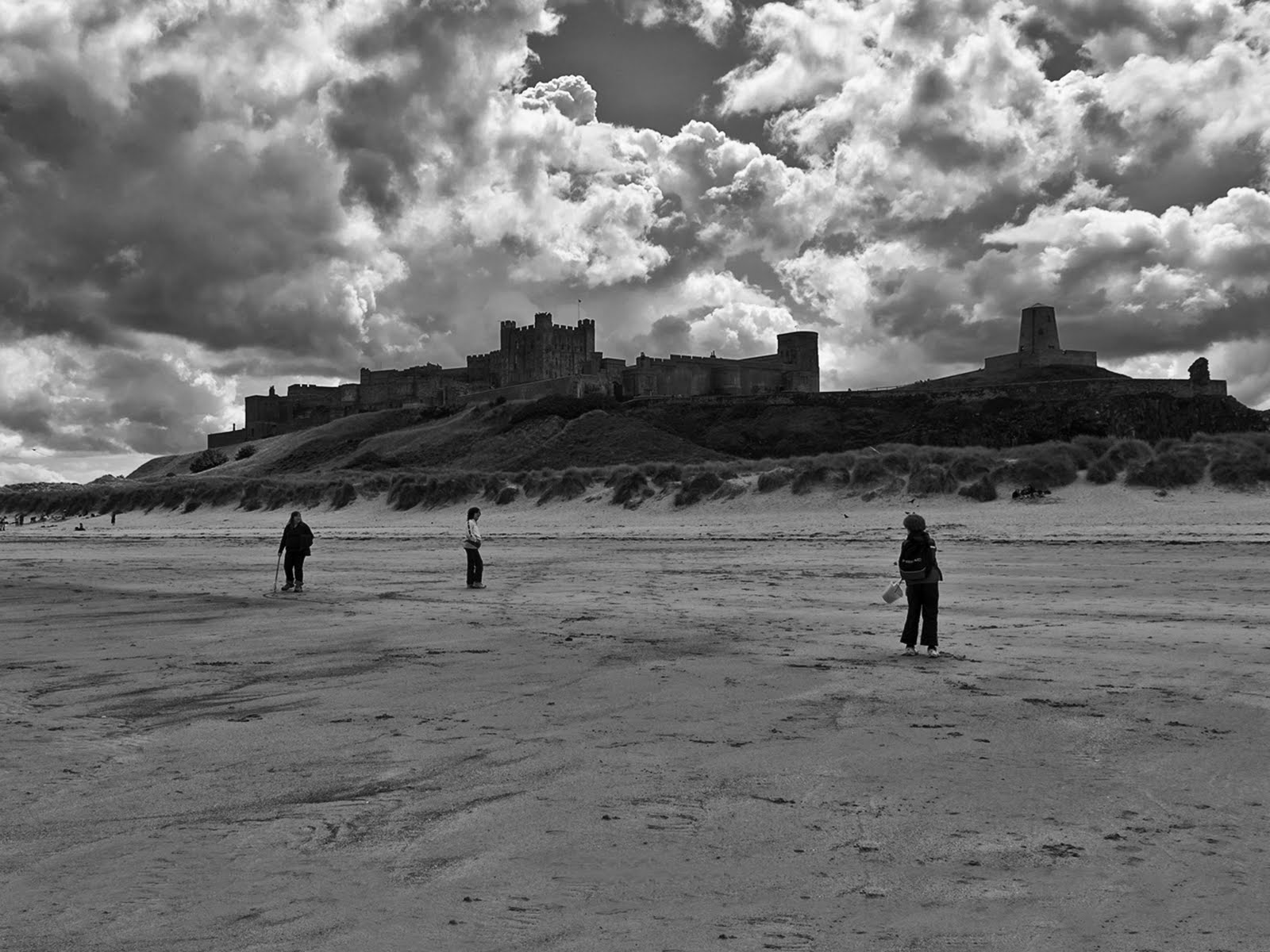
Being an island race we have long had to defend our shores. Some defences dominate the shoreline but because of their age and familiarity and their use of local materials they are seen as a 'natural' part of the area in which they stand such as at Bambergh Castle in Northumberland.
In later times the fear of invasion by Napoleon's forces led to the construction of defensive towers along our eastern and southern coastlines.

Here the two Martello towers seen on the horizon are reminders of more fearful times. Again time and familiarity have lled to their acceptance and in some cases conversion to other uses.
Of course the coast has offered man many benefits not least in the carrying out of trade with other Countries. Modern containerisation has led to investment in container ports with their massive cranes dominating the skyline for miles around. Harwich harbour remains very much a traditional port yet just a short distance up the coast is Britain's largest container port - Felixstowe.

Shot from Harwich we see the clutter and debris so much part of man's presence. Often we forget that much that is unsightly along our coast is caused by the thoughtlessness of people who care little for the disfigurement caused by their neglect. In the distance the disfiguring of the skyline by the giant cranes of the Container port at Felixstowe.
Even so for many of us the seaside is a day out for pleasure and indulgence. Unfortunately there is a price to pay and what is one man's pleasure beach is another man's nightmare. Skegness Pleasure Beach represents the many similar features up and down our Coast. I wonder what the planning authorities would say now if proposals were made for a similar invasion.

This image of Great Yarmouth at sunset shows yet another impact of man - light pollution. We are so used to it in all our towns and cities that we no longer see it as being a nuisance or possibly not see it all.

Perhaps the most disturbing feature of the use of our coastline is the building of nuclear power stations. Justified on the grounds of less risk to the population at large as Chernobyl and recent events in Japan has shown a major catastrophe puts millions at risk across a vast tract of our planet wherever the Plant is located.

Here at Dungeness in Kent the power station stands in juxtaposition to the old lighthouse. The are two nuclear power stations here; one of which is now being decommissioned whilst the other has an expected life until 2016. The necessary transmission lines are visible for miles.
We take for granted much of what is around us and, probably for most without thinking the gradual erosion by man's activities of the Coast that has been a source of enjoyment and relaxation for the last two centuries. Man has long earned his living from the bounty of the ocean but now there is heavy reliance on the tourist trade that brings not only cash to the economy but also the hidden price of over-use of the resources. One has only to pay a short visit to most of our Coast to realise that we are rapidly losing that which we hold most dear.
Wednesday, 17 August 2011
Visual Studies - UVC Fetishising the object of your eye.
In the Course material we are asked to note questions that occur to us as we read through the set reading. I found myself constantly asking where the conclusions drawn by the writers or those whom they quoted had come from. As is common in Psychology a selection of words or terms such as 'devour' are used to support whatever argument the writer is presenting. The question I always ask is it a fair selection in so far as the word is in common use in the same context and can the conclusions offered be verified if other less emotive terms are used. Further questions arise when bald statements are made that suggest that what is stated is a given fact. Whilst it is not surprising for a Freudian to see the eye as the penis or that young boys have a very real fear of castration the evidence is very limited and is an assumption that is carried into the analysis by the analyst so it is not surprising that it is found to be the case. It is often valuable to compare the work and statements by Freud with the followers of Jung or Adler.
Critics of the Freudian approach point out that many of his conclusions are drawn from work with a very limited number of cases that are not typical or representative of the general population. Based on a very small sample the theory is then 'found' in others.A good example is in the final part of the Otto Fenchel 1 extract where he discusses the problems of the psychogenesis of myopia.
My experience is that psychology in general and psychoanalysis in particular has much to offer in individual cases but that extrapolating the findings to the general population is fraught with danger. The differing approaches adopted by those who follow the teachings of Freud or those having Jungian training are in themselves problematic and the differences inside the many disciplines only make the problems worse.
How then is it possible to use the information in the Reader to make any generalised statements about how each individual sees the world and in particular - art? Is there any value in trying to decide if an object is a 'fetish' in any individual case? Seeing a landscape painting as a 'replacement' for real countryside may, in an individual case, be a reasonable view in the particular but I would guess that there are as many if not more that either see it as just something to fill a gap or to complement the general decor. I am a photographer and my favourite genre is landscape and the photographs I display on my walls are of landscapes. Am I to conclude from this that they are a 'replacement' for the real countryside (assuming there is such a thing as 'real' countryside). All I can say is that I live in the country and spend a great deal of my time passing through country that I find outstanding. I am aware that the photographs that I have chosen from many hundreds are those that evoke a particular memory or emotional response within me.
"How does what you have read help your understanding of why and how we look at things in a ritualised way - for instance going to an art gallery?"
There is a built in assumption within the question - that we look at things in a 'ritualised way'. There is no evidence offered to suggest that this is the case . I assume the term is not being used in a psychological sense where it defines a set of actions adopted by a person to relieve anxiety or stress (e.g checking, more than once, that doors and windows are locked before leaving the house) that interfere with that person's life - sometimes described as obsessive compulsive disorder. In a general use of the term 'rituals' i.e. a set of actions, can aid in the creation of group identity. Applying this to a visit to an art gallery it is evident from observation there is an agreed way of behaving that seems to impinge itself on everyone that enters. Certain types of behaviour are frowned upon and those seen stepping outside the norm are judged to be 'not one of us'.
One can usefully compare a visit to a public art gallery to a viewing at a private gallery. In the former case there is no particular form of dress requirement and you are not seen to be not part of the group based on your dress code. There is a general acceptance of not getting into the view line of someone else nor discussing any particular painting in a loud voice. Observation (I worked within walking distance of the Tate and spent many a lunch hour wandering around) suggests that visitors begin to adopt a stance for looking at the pictures that mimics that of those around them. Probably based on the desire to be part of the group and not to be seen as different in some way. A similar phenomenon can be seen in museums that suggests that most of us have a desire to be part of the social grouping that visits places of 'learning' which is probably a sub-set of the desire to 'belong' to a group that is very strong in most humans.
In the latter case - the showing at a private gallery - dress code is exactly that - a code. There are those who see the occasion to dress to show their superiority and possibly wealth. There are also those who dress to emphasise their difference and to reject the norms and values of other groups but frequently find themselves part of a group anyway because there are others who have adopted the same dress code. It is also not unusual to hear very loud discussions of the exhibits that enable the speaker to display their knowledge (or in some cases - ignorance) of the type of art being viewed. Interestingly if one can survive long enough there arrives a point at which views start to coalesce around that expressed by the dominant personality present (again behaviour that is common to many group meetings.).
Group behaviour is a well studied area by a whole range of behaviour analysts. From an early age we learn how to behave within a group and how to be accepted within that group. Initially it may be by direct instruction from parents or significant others, or by painful rejection but gradually we learn a strategy that works in the majority of cases and use it to test the waters in any new grouping with which we are faced. Rebellious teenagers who avowedly reject the norms of their parents or other groups seem always to seek out a group that share their current value set. The elderly who reject all things modern also surround themselves surrounded by similar thinking people. The group provides verification of our identity and through belonging strengthens our convictions that we are right.
It will be fairly evident that my answer to the stated question would be a blunt 'No'. I find that my experience of Freudian thinking and its obsession with sex, whilst in itself may offer solutions to individual problems, offers very little in terms of society and the individual make up of those who are part of that society.
"Do the articles suggest to you reasons for staring at someone being at best bad manners and at worst threatening".
If one accepts the idea that the eye is seen as the penis (I have to admit that this is the first time that I have ever come across this idea) then clearly staring would be seen as both bad manners and extremely threatening. Is this the case for both sexes or is it more threatening for the female who presumably sees it as the start to sexual violation? If the starer is homosexual should a man being stared at respond in a similar way to that of a woman? Is it necessary for there to be awareness of the concept of the penis eye in the viewed before any reaction or is there somehow a genetic element to our make up where sub-consciously we are aware of the phallic nature of the eye? Is there any real evidence, other than in the world of Freud, that such a concept exists or is this on a par with reactions to such things as the 'bogeyman'?
A lot of the myths of our childhood designed to frighten or control have elements of the staring 'monster' or of the 'magic' eye that in some way has the ability to control the victim. It may be the case that these memories remain with us and affect our reactions to someone who stares at us or looks at us longer than is usual. Loss of control is an underlying fear with most and the thought that someone is capable of taking control of our actions just by looking at us is disturbing. These buried memories would be re-inforced by watching the success of the hypnotist in getting people to do something that is not part of their normal behaviour pattern. Films made for children such as Jungle Book re-inforce the message by presenting the snake as having the ability to hypnotise humans (think what happens to Mowgli).
Given such conditioning it is not unreasonable to see why we find staring objectionable.
However there are other elements of learning/conditioning that have to be taken into account. Very young babies pick up their information about the world around them by visual and tactile contact. A long hard stare by an adult is seen to be threatening by most and it can be argued that this is early learned behaviour. Very young infants quickly learn when a situation is threatening by receiving the same messages that on a previous occasion led to its discomfort or possibly pain. If there is an association between the parent or other adult staring and discomfort/pain then this pattern becomes imprinted and carried forward into adulthood.
There is also a cultural element. Different cultures have different 'rules' for eye contact. First meetings between different cultures can be made difficult where one culture sees sustained eye contact as showing politeness and interest whilst seen by another culture as the height of rudeness.
"Can you make any suggestions as to the reasons some people need to avidly watch television?"
I make the assumption that 'need' in this case refers to an irresistible desire to avidly watch television as opposed to someone who has either work that requires that they watch television or, say, an interest in stocks and shares so that the watching has a financial reason. Furthermore I assume that the time spent watching television is out of the ordinary or even could be considered abnormal or all other activities are put on hold in order to watch a favourite television programme.
Presumably the watcher gains pleasure or benefit from the activity greater than he would experience from other activities. Becoming totally absorbed into the world as portrayed in a soap opera to the extent that the characters are 'seen' as real people and that their portrayed lives are real suggests that it is escapism from something in their lives the avid watcher finds difficult to tolerate. It is a feature that existed even in the time of radio programmes that followed the lives of 'ordinary people' as was demonstrated when one of the characters in the Archers died in a fire and many wreaths were sent by listeners to the supposed funeral.
If we describe a fetish as something that takes the place of something in the real world that is seen as unobtainable or unapproachable then avid watching of television can be described as a fetish. An obsessive desire to see a particular person on television either as real or as a character and fantasise about the relationship between the watcher and the watched can also be seen as a fetish whether there are sexual overtones or not.
Similar conclusions can be drawn from the total involvement of a person in computer games for many hours a day to the exclusion of all other activities such as social interaction.
If we live in a world that we see as hostile and uncaring or in which our desires remain unfulfilled then the opportunity to escape offered by 'other' worlds can prove irresistible. In our fantasy world all things are achievable and we remain masters of our own destiny - something that is not obtainable in what we see as the real world.
" What visual fetishes have you noted in everyday life - your own or others"?
As far as I am aware I do not have any fetishes in my own life although presumably this is something I would not know. To me what could be described as a fetish by others is seen by me as a natural part of my life. In others I can only make a judgement based on my belief about how an object is seen by the other person. I can have no direct evidence unless I am happy to assign such a status to everyday objects. For example religious symbols are, by one definition, fetishes. The picture of Christ on the Cross is representative of the suffering he bore for the redemption of our sins; communion is his flesh and blood; and icons of the saints represent the good that we should all aspire to in our lives. To the atheist all of that is just nonsense.
I do not see how this question can be answered honestly or with any conviction because we cannot, for the most part, make a judgement based on what evidence we can acquire.
"Why are people so often so keen to display wedding photos or family portraits."
Photos or portraits act as reminder of certain times or events in the lives of members of our family. We get an emotional reaction to the image that has some links to the event at the time of the photograph. We remember happy or sad times and this can trigger a whole flood of memories linked either to the person shown, the event itself or linked memories such as seeing Aunty Dot may remind us of the time she fell into the sea from Skegness Pier.
We may also surround ourselves with family portraits in order to protect ourselves from the reality of our actual familial relationships. Being able to look back on happier times may help us avoid the sadness of a broken relationship or rift within the family as a whole. We are replacing the reality of the present world with something that brings memories of happier times (or perhaps the opposite situation).
In photos people don't grow old, they don't suffer from crippling diseases, they don't die and the sun always seems to shine. They freeze time for ever. Looking at images of your children as babies reminds you of yourself as much younger person with your hopes and ambition still in front of you. It gives the opportunity to reflect. Whether it is a happy thought process or otherwise is what you are or have become.
References
1 Otto Fenichel (1954) IN: visual culture: the reader; eds jessica evans and stuart hall; Sage Publications Ltd 2010
Critics of the Freudian approach point out that many of his conclusions are drawn from work with a very limited number of cases that are not typical or representative of the general population. Based on a very small sample the theory is then 'found' in others.A good example is in the final part of the Otto Fenchel 1 extract where he discusses the problems of the psychogenesis of myopia.
My experience is that psychology in general and psychoanalysis in particular has much to offer in individual cases but that extrapolating the findings to the general population is fraught with danger. The differing approaches adopted by those who follow the teachings of Freud or those having Jungian training are in themselves problematic and the differences inside the many disciplines only make the problems worse.
How then is it possible to use the information in the Reader to make any generalised statements about how each individual sees the world and in particular - art? Is there any value in trying to decide if an object is a 'fetish' in any individual case? Seeing a landscape painting as a 'replacement' for real countryside may, in an individual case, be a reasonable view in the particular but I would guess that there are as many if not more that either see it as just something to fill a gap or to complement the general decor. I am a photographer and my favourite genre is landscape and the photographs I display on my walls are of landscapes. Am I to conclude from this that they are a 'replacement' for the real countryside (assuming there is such a thing as 'real' countryside). All I can say is that I live in the country and spend a great deal of my time passing through country that I find outstanding. I am aware that the photographs that I have chosen from many hundreds are those that evoke a particular memory or emotional response within me.
"How does what you have read help your understanding of why and how we look at things in a ritualised way - for instance going to an art gallery?"
There is a built in assumption within the question - that we look at things in a 'ritualised way'. There is no evidence offered to suggest that this is the case . I assume the term is not being used in a psychological sense where it defines a set of actions adopted by a person to relieve anxiety or stress (e.g checking, more than once, that doors and windows are locked before leaving the house) that interfere with that person's life - sometimes described as obsessive compulsive disorder. In a general use of the term 'rituals' i.e. a set of actions, can aid in the creation of group identity. Applying this to a visit to an art gallery it is evident from observation there is an agreed way of behaving that seems to impinge itself on everyone that enters. Certain types of behaviour are frowned upon and those seen stepping outside the norm are judged to be 'not one of us'.
One can usefully compare a visit to a public art gallery to a viewing at a private gallery. In the former case there is no particular form of dress requirement and you are not seen to be not part of the group based on your dress code. There is a general acceptance of not getting into the view line of someone else nor discussing any particular painting in a loud voice. Observation (I worked within walking distance of the Tate and spent many a lunch hour wandering around) suggests that visitors begin to adopt a stance for looking at the pictures that mimics that of those around them. Probably based on the desire to be part of the group and not to be seen as different in some way. A similar phenomenon can be seen in museums that suggests that most of us have a desire to be part of the social grouping that visits places of 'learning' which is probably a sub-set of the desire to 'belong' to a group that is very strong in most humans.
In the latter case - the showing at a private gallery - dress code is exactly that - a code. There are those who see the occasion to dress to show their superiority and possibly wealth. There are also those who dress to emphasise their difference and to reject the norms and values of other groups but frequently find themselves part of a group anyway because there are others who have adopted the same dress code. It is also not unusual to hear very loud discussions of the exhibits that enable the speaker to display their knowledge (or in some cases - ignorance) of the type of art being viewed. Interestingly if one can survive long enough there arrives a point at which views start to coalesce around that expressed by the dominant personality present (again behaviour that is common to many group meetings.).
Group behaviour is a well studied area by a whole range of behaviour analysts. From an early age we learn how to behave within a group and how to be accepted within that group. Initially it may be by direct instruction from parents or significant others, or by painful rejection but gradually we learn a strategy that works in the majority of cases and use it to test the waters in any new grouping with which we are faced. Rebellious teenagers who avowedly reject the norms of their parents or other groups seem always to seek out a group that share their current value set. The elderly who reject all things modern also surround themselves surrounded by similar thinking people. The group provides verification of our identity and through belonging strengthens our convictions that we are right.
It will be fairly evident that my answer to the stated question would be a blunt 'No'. I find that my experience of Freudian thinking and its obsession with sex, whilst in itself may offer solutions to individual problems, offers very little in terms of society and the individual make up of those who are part of that society.
"Do the articles suggest to you reasons for staring at someone being at best bad manners and at worst threatening".
If one accepts the idea that the eye is seen as the penis (I have to admit that this is the first time that I have ever come across this idea) then clearly staring would be seen as both bad manners and extremely threatening. Is this the case for both sexes or is it more threatening for the female who presumably sees it as the start to sexual violation? If the starer is homosexual should a man being stared at respond in a similar way to that of a woman? Is it necessary for there to be awareness of the concept of the penis eye in the viewed before any reaction or is there somehow a genetic element to our make up where sub-consciously we are aware of the phallic nature of the eye? Is there any real evidence, other than in the world of Freud, that such a concept exists or is this on a par with reactions to such things as the 'bogeyman'?
A lot of the myths of our childhood designed to frighten or control have elements of the staring 'monster' or of the 'magic' eye that in some way has the ability to control the victim. It may be the case that these memories remain with us and affect our reactions to someone who stares at us or looks at us longer than is usual. Loss of control is an underlying fear with most and the thought that someone is capable of taking control of our actions just by looking at us is disturbing. These buried memories would be re-inforced by watching the success of the hypnotist in getting people to do something that is not part of their normal behaviour pattern. Films made for children such as Jungle Book re-inforce the message by presenting the snake as having the ability to hypnotise humans (think what happens to Mowgli).
Given such conditioning it is not unreasonable to see why we find staring objectionable.
However there are other elements of learning/conditioning that have to be taken into account. Very young babies pick up their information about the world around them by visual and tactile contact. A long hard stare by an adult is seen to be threatening by most and it can be argued that this is early learned behaviour. Very young infants quickly learn when a situation is threatening by receiving the same messages that on a previous occasion led to its discomfort or possibly pain. If there is an association between the parent or other adult staring and discomfort/pain then this pattern becomes imprinted and carried forward into adulthood.
There is also a cultural element. Different cultures have different 'rules' for eye contact. First meetings between different cultures can be made difficult where one culture sees sustained eye contact as showing politeness and interest whilst seen by another culture as the height of rudeness.
"Can you make any suggestions as to the reasons some people need to avidly watch television?"
I make the assumption that 'need' in this case refers to an irresistible desire to avidly watch television as opposed to someone who has either work that requires that they watch television or, say, an interest in stocks and shares so that the watching has a financial reason. Furthermore I assume that the time spent watching television is out of the ordinary or even could be considered abnormal or all other activities are put on hold in order to watch a favourite television programme.
Presumably the watcher gains pleasure or benefit from the activity greater than he would experience from other activities. Becoming totally absorbed into the world as portrayed in a soap opera to the extent that the characters are 'seen' as real people and that their portrayed lives are real suggests that it is escapism from something in their lives the avid watcher finds difficult to tolerate. It is a feature that existed even in the time of radio programmes that followed the lives of 'ordinary people' as was demonstrated when one of the characters in the Archers died in a fire and many wreaths were sent by listeners to the supposed funeral.
If we describe a fetish as something that takes the place of something in the real world that is seen as unobtainable or unapproachable then avid watching of television can be described as a fetish. An obsessive desire to see a particular person on television either as real or as a character and fantasise about the relationship between the watcher and the watched can also be seen as a fetish whether there are sexual overtones or not.
Similar conclusions can be drawn from the total involvement of a person in computer games for many hours a day to the exclusion of all other activities such as social interaction.
If we live in a world that we see as hostile and uncaring or in which our desires remain unfulfilled then the opportunity to escape offered by 'other' worlds can prove irresistible. In our fantasy world all things are achievable and we remain masters of our own destiny - something that is not obtainable in what we see as the real world.
" What visual fetishes have you noted in everyday life - your own or others"?
As far as I am aware I do not have any fetishes in my own life although presumably this is something I would not know. To me what could be described as a fetish by others is seen by me as a natural part of my life. In others I can only make a judgement based on my belief about how an object is seen by the other person. I can have no direct evidence unless I am happy to assign such a status to everyday objects. For example religious symbols are, by one definition, fetishes. The picture of Christ on the Cross is representative of the suffering he bore for the redemption of our sins; communion is his flesh and blood; and icons of the saints represent the good that we should all aspire to in our lives. To the atheist all of that is just nonsense.
I do not see how this question can be answered honestly or with any conviction because we cannot, for the most part, make a judgement based on what evidence we can acquire.
"Why are people so often so keen to display wedding photos or family portraits."
Photos or portraits act as reminder of certain times or events in the lives of members of our family. We get an emotional reaction to the image that has some links to the event at the time of the photograph. We remember happy or sad times and this can trigger a whole flood of memories linked either to the person shown, the event itself or linked memories such as seeing Aunty Dot may remind us of the time she fell into the sea from Skegness Pier.
We may also surround ourselves with family portraits in order to protect ourselves from the reality of our actual familial relationships. Being able to look back on happier times may help us avoid the sadness of a broken relationship or rift within the family as a whole. We are replacing the reality of the present world with something that brings memories of happier times (or perhaps the opposite situation).
In photos people don't grow old, they don't suffer from crippling diseases, they don't die and the sun always seems to shine. They freeze time for ever. Looking at images of your children as babies reminds you of yourself as much younger person with your hopes and ambition still in front of you. It gives the opportunity to reflect. Whether it is a happy thought process or otherwise is what you are or have become.
References
1 Otto Fenichel (1954) IN: visual culture: the reader; eds jessica evans and stuart hall; Sage Publications Ltd 2010
Sunday, 14 August 2011
UVC - Modernist Art: the critic speaks
Greenberg indicates that the purpose of his article is to plot the rationale of 'Modernist Art' The argument fundamental to article is his belief that Modernism arises from a desire to distinguish the arts one from the other. In an earlier article [ 'Towards a Newer Laocoon']1 Greenberg states "It is by virtue of its medium that each art is unique and strictly itself'. By using the characteristic methods of a discipline to criticise that discipline, an approach used by the philosopher Emmanuel Kant in his Critique of Pure Reason to examine logic, one should reach that which makes the art unique. He further argues that "Purity in art consists in the acceptance, willing acceptance, of the limitations of the medium of the specific art."2. That of course raises the issue of what the limitations are for painting.
Although he suggests that Kantian methods have been used to arrive at the answer he fails to show how the conclusion was reached which leaves the reader having to accept it as a given truth. With this proviso we learn from him: "The limitations that constitute the medium of painting - [are] the flat surface, the shape of the support, the properties of the pigment...."3. It is legitimate to ask if any other art form has these limitations because if the answer is Yes then painting is not made unique by these limitations and is therefore part of a wider set of arts that are limited by a flat surface and thus undermining Greenberg's whole argument. An immediate art form that springs to mind is that of photography where the limitations are almost identical. Certainly there is the flat surface and the shape of the support (I make the assumption that the 'support' is the paper itself) and one could argue that ink pigments are of the same ilk as paint used by an artist. Perhaps stretching the argument too far it could also be argued that television and cinema have the same limitations.
Supporters of Greenberg could, and probably would, argue that photography is not an 'art' and therefore Greenberg's argument remains sound. However the borderline between painting and photography in the final outcome of the work is blurred to say the least. Lets put the argument to one side because the purpose of this blog is not to argue one way or the other.
In the article read for this blog 4 Greenberg develops his argument. Again no evidence is provided for his assertion that there was a risk that "art was in danger of being assimilated into entertainment and that entertainment was at risk of being assimilated into therapy". He continues "The arts could save themselves from this levelling down only by demonstrating that the kind of experience they provided was valuable in its own right and not to be obtained from any other kind of activity" 5. In my view this does not necessarily mean that it is not of the class 'entertainment' because many activities that are widely accepted as entertainment could argue that what they provide is valuable in its own right and not available elsewhere.
He makes a more assertive statement: "Flatness alone was unique and exclusive to that art.... Flatness, two-dimensionality was the only condition painting shared with no other art."6 As noted above this may be true or not and as will be shown later not even Greenberg is wholly convinced of the truth of the statement. Assuming for the moment that the statement is true we then need to discover how the Modernists tackled this limitation in their work.
Greenberg offers the following : "What it [Modernist Painting] has abandoned in principle is the representation of the kind of space that recognisable, three-dimensional objects can inhabit... Three-dimensionality is the province of sculpture, and for the sake of its own autonomy painting has had above all to divest itself of everything it might share with sculpture."7 Yet can this be true or indeed is it possible? One element that the artist cannot control is the viewer, a human being, subject to all the contraries of both his/her own unique make up biologically and that of experience gained through the years. Most humans attempt to make sense of objects, including paintings, however obscure or clueless the evidence, in order to fit that object within a class that he/she understands. Faced with say a Mondrian we will attempt to make sense of the rectangles of colour and their placing by applying what we 'know'. The unique result for us may not be what the artist intended or anticipated. For most of us our world is three-dimensional and we are in a sense programmed to try to create 3D objects from the scantiest of information.
Am I convinced by Greenberg's article. In brief - No. Not least because towards the end of the article he tells the reader: "It is understood, I hope, that in plotting the rationale of Modernist art I have had to simplify and exaggerate. The flatness towards which Modernist painting orients itself can never be an utter flatness."8 He is saying that the evidence that he has presented for our consideration has been changed and one must conclude from this that the changes made are such as to support his argument. Perhaps the most telling comment is "No one artist was, or is yet, consciously aware of this tendency, nor could an artist work successfully in conscious awareness of it"9. If this is the case then it is difficult if not impossible to understand how the movement happened. The only explanation is that the term 'Modernist' is simply an umbrella applied for convenience to a number of disparate styles that may or may not have been attempts to paint within the constraints of the flat surface.
In conclusion I am not convinced that Greenberg has successfully shown that painting is unique and has fundamentals that it does not share with other arts.
References:
1 Greenberg Clement: Towards a New Laocoon 1940 In: Art in Theory 1900 - 2000 An Anthology of Changing Ideas; eds Charles Harrison & Paul Wood New Edition 2003 Blackwell Publishing p566
2 op cit p566
3 Greenberg Clement: Modernist Painting In: Art in Theory 1900 - 2000 An Anthology of Changing Ideas; eds Charles Harrison & Paul Wood New Edition 2003 Blackwell Publishing p 775
4 op cit pp 773 -779
5 op cit p 774
6 op cit p 775
7 op cit p775
8 op cit p777
9 op cit p778
Although he suggests that Kantian methods have been used to arrive at the answer he fails to show how the conclusion was reached which leaves the reader having to accept it as a given truth. With this proviso we learn from him: "The limitations that constitute the medium of painting - [are] the flat surface, the shape of the support, the properties of the pigment...."3. It is legitimate to ask if any other art form has these limitations because if the answer is Yes then painting is not made unique by these limitations and is therefore part of a wider set of arts that are limited by a flat surface and thus undermining Greenberg's whole argument. An immediate art form that springs to mind is that of photography where the limitations are almost identical. Certainly there is the flat surface and the shape of the support (I make the assumption that the 'support' is the paper itself) and one could argue that ink pigments are of the same ilk as paint used by an artist. Perhaps stretching the argument too far it could also be argued that television and cinema have the same limitations.
Supporters of Greenberg could, and probably would, argue that photography is not an 'art' and therefore Greenberg's argument remains sound. However the borderline between painting and photography in the final outcome of the work is blurred to say the least. Lets put the argument to one side because the purpose of this blog is not to argue one way or the other.
In the article read for this blog 4 Greenberg develops his argument. Again no evidence is provided for his assertion that there was a risk that "art was in danger of being assimilated into entertainment and that entertainment was at risk of being assimilated into therapy". He continues "The arts could save themselves from this levelling down only by demonstrating that the kind of experience they provided was valuable in its own right and not to be obtained from any other kind of activity" 5. In my view this does not necessarily mean that it is not of the class 'entertainment' because many activities that are widely accepted as entertainment could argue that what they provide is valuable in its own right and not available elsewhere.
He makes a more assertive statement: "Flatness alone was unique and exclusive to that art.... Flatness, two-dimensionality was the only condition painting shared with no other art."6 As noted above this may be true or not and as will be shown later not even Greenberg is wholly convinced of the truth of the statement. Assuming for the moment that the statement is true we then need to discover how the Modernists tackled this limitation in their work.
Greenberg offers the following : "What it [Modernist Painting] has abandoned in principle is the representation of the kind of space that recognisable, three-dimensional objects can inhabit... Three-dimensionality is the province of sculpture, and for the sake of its own autonomy painting has had above all to divest itself of everything it might share with sculpture."7 Yet can this be true or indeed is it possible? One element that the artist cannot control is the viewer, a human being, subject to all the contraries of both his/her own unique make up biologically and that of experience gained through the years. Most humans attempt to make sense of objects, including paintings, however obscure or clueless the evidence, in order to fit that object within a class that he/she understands. Faced with say a Mondrian we will attempt to make sense of the rectangles of colour and their placing by applying what we 'know'. The unique result for us may not be what the artist intended or anticipated. For most of us our world is three-dimensional and we are in a sense programmed to try to create 3D objects from the scantiest of information.
Am I convinced by Greenberg's article. In brief - No. Not least because towards the end of the article he tells the reader: "It is understood, I hope, that in plotting the rationale of Modernist art I have had to simplify and exaggerate. The flatness towards which Modernist painting orients itself can never be an utter flatness."8 He is saying that the evidence that he has presented for our consideration has been changed and one must conclude from this that the changes made are such as to support his argument. Perhaps the most telling comment is "No one artist was, or is yet, consciously aware of this tendency, nor could an artist work successfully in conscious awareness of it"9. If this is the case then it is difficult if not impossible to understand how the movement happened. The only explanation is that the term 'Modernist' is simply an umbrella applied for convenience to a number of disparate styles that may or may not have been attempts to paint within the constraints of the flat surface.
In conclusion I am not convinced that Greenberg has successfully shown that painting is unique and has fundamentals that it does not share with other arts.
References:
1 Greenberg Clement: Towards a New Laocoon 1940 In: Art in Theory 1900 - 2000 An Anthology of Changing Ideas; eds Charles Harrison & Paul Wood New Edition 2003 Blackwell Publishing p566
2 op cit p566
3 Greenberg Clement: Modernist Painting In: Art in Theory 1900 - 2000 An Anthology of Changing Ideas; eds Charles Harrison & Paul Wood New Edition 2003 Blackwell Publishing p 775
4 op cit pp 773 -779
5 op cit p 774
6 op cit p 775
7 op cit p775
8 op cit p777
9 op cit p778
Subscribe to:
Comments (Atom)